Designing and making electronics for phantom power mic

Sean Reeser

Freshman
Jan 9, 2016
2
0
0
Hello all. I'm new here, so I just have to hope this is a good place to ask about this. I'm having an electronics engineering type of problem.
I'm trying to figure out how to make myself a mute switch and volume adjustment, either in the same unit or with the mute on my pocket and the adjuster on the floor. The fun part is that I use a condenser-based instrument mic that needs 48V phantom power, so anything I use has to pass that voltage. That also means I can't convert any line-based gear.
The volume control is what's really throwing me for a loop. I know very few normal pots can survive 48V, so I need an alternative. I know there are rheostats that can take that voltage - can they be used in this application? Are there any other types of variable resistors I should look at?
Also, I don't know how I would go about wiring such an adjuster - I'd be concerned that it might make a lot of noise if I run it the same way as guitar stuff. Can anyone help me there?
Thanks.

P.S. I do know a bit more about engineering than your average musician, and I have relatives with all manner of engineering degrees if you toss me something I don't understand.
 
Re: Designing and making electronics for phantom power mic

Hello all. I'm new here, so I just have to hope this is a good place to ask about this. I'm having an electronics engineering type of problem.
I'm trying to figure out how to make myself a mute switch and volume adjustment, either in the same unit or with the mute on my pocket and the adjuster on the floor. The fun part is that I use a condenser-based instrument mic that needs 48V phantom power, so anything I use has to pass that voltage. That also means I can't convert any line-based gear.
The volume control is what's really throwing me for a loop. I know very few normal pots can survive 48V, so I need an alternative. I know there are rheostats that can take that voltage - can they be used in this application? Are there any other types of variable resistors I should look at?
Also, I don't know how I would go about wiring such an adjuster - I'd be concerned that it might make a lot of noise if I run it the same way as guitar stuff. Can anyone help me there?
Thanks.

P.S. I do know a bit more about engineering than your average musician, and I have relatives with all manner of engineering degrees if you toss me something I don't understand.

I've seen a number of designs out there similar to what you are asking. But why can't you just put your volume adjust/mute after the bias-tee you use to supply power to the capsule? Using a local power source like a battery, instead of remote phantom power. You also need to properly handle the condition where the capsule is connected/disconnected from the power supply if you allow disconnecting. But you'll probably end up with a lower noise design.

Otherwise, decouple the remote phantom power, filter and use for a local power supply. You could use one of those COTS PGA chips to do the mute/attenuation with. Still you will need to supply power to the capsule so you need to make sure the parts in your bias-tee are not attenuating too much of the AC signal.
 
Last edited:
Re: Designing and making electronics for phantom power mic

Mute is straightforward, as you can simply remove the DC ground reference and your mic will stop working. Volume control is a bit more tricky.

There are a few ways to approach this. The simplest is to provide phantom power for your microphone after your mute box, allowing you to treat your signal as a pure audio signal without any additional DC offset. In this case, you could use pretty much any approach you'd like for both mute and volume. Even if you don't want to provide phantom power locally, you'll still need to remove and reapply the DC bias to the audio line. A resistive pad won't work, as it will also affect the phantom power.
 
Re: Designing and making electronics for phantom power mic

Mute is straightforward, as you can simply remove the DC ground reference and your mic will stop working. Volume control is a bit more tricky.


Hello

Above system provides LOUD pop and can lead to serious damage if it gets onto speakers !!!


Simplest and at same time quiet mute is the same as in dynamic mics - short switch between pins 2 & 3 - audio gets muted while phantom power remains ON. Thus no pop.

As of volume control - I have been pondering that same question for my GUILD Songbird, which I have converted so it has XLR-output with Lundahl x-former and uses phantom - original 1/4-inch jack got tired and noisy and unreliable - it is still there to be for AUX-connections ...

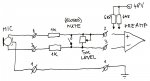
I would try using a network consisting of two 200 - 1000 Ohm resistors in series from pin 2 and 3 onto output x-former plus10 k potentiometer between pins 2 & 3 - ( mute switch could be parallel to this ) - the potentiometer would only reduce the audio and have no effect on phantom - the series resistors are there to keep some impedance at x-former output, when volume is down, so that the output stage does not get too heavily loaded.

This needs experimenting to find right values.


EDIT - naturally those series resistors take away a little bit of phantom - not much - so one could end up with slightly reduced performance of connected mic - but only on microphones that need full 48 to operate within specs - many work fine on lower voltages, too.
 
Last edited:
Re: Designing and making electronics for phantom power mic

Mute is straightforward, as you can simply remove the DC ground reference and your mic will stop working. Volume control is a bit more tricky.
Hello

Above system provides LOUD pop and can lead to serious damage if it gets onto speakers !!!

Simplest and at same time quiet mute is the same as in dynamic mics - short switch between pins 2 & 3 - audio gets muted while phantom power remains ON. Thus no pop.

As of volume control - I have been pondering that same question for my GUILD Songbird, which I have converted so it has XLR-output with Lundahl x-former and uses phantom - original 1/4-inch jack got tired and noisy and unreliable - it is still there to be for AUX-connections ...

I would try using a network consisting of two 200 - 1000 Ohm resistors in series from pin 2 and 3 onto output x-former plus10 k potentiometer between pins 2 & 3 - ( mute switch could be parallel to this ) - the potentiometer would only reduce the audio and have no effect on phantom - the series resistors are there to keep some impedance at x-former output, when volume is down, so that the output stage does not get too heavily loaded.

This needs experimenting to find right values.

EDIT - naturally those series resistors take away a little bit of phantom - not much - so one could end up with slightly reduced performance of connected mic - but only on microphones that need full 48 to operate within specs - many work fine on lower voltages, too.
I know how to wire the mute switch. Shorting pins 2 and 3 upstream of the mic is ideal for XLR and necessary with phantom power.

I'm a bit confused about your suggestion for the volume control.
First, what does the transformer do in this circuit, and what value of one would I need?
Do you think you could give me a schematic of what you described?
Thank you for your time and expertise.
 
Re: Designing and making electronics for phantom power mic

Hello all. I'm new here, so I just have to hope this is a good place to ask about this. I'm having an electronics engineering type of problem.
I'm trying to figure out how to make myself a mute switch and volume adjustment, either in the same unit or with the mute on my pocket and the adjuster on the floor. The fun part is that I use a condenser-based instrument mic that needs 48V phantom power, so anything I use has to pass that voltage. That also means I can't convert any line-based gear.
The volume control is what's really throwing me for a loop. I know very few normal pots can survive 48V, so I need an alternative. I know there are rheostats that can take that voltage - can they be used in this application? Are there any other types of variable resistors I should look at?
Also, I don't know how I would go about wiring such an adjuster - I'd be concerned that it might make a lot of noise if I run it the same way as guitar stuff. Can anyone help me there?
Thanks.

P.S. I do know a bit more about engineering than your average musician, and I have relatives with all manner of engineering degrees if you toss me something I don't understand.

Phantom mic mute level.jpg

Works like a charm.
I hope this is helpful.

Respectfully !!
 
Re: Designing and making electronics for phantom power mic

Hello

ALES - thank you for providing the drawing.
SEAN - I was between taking a 10 week old puppy out and getting to read evening fairytale for a kid - so I was concentrating on my plan on my Guild guitar, which has the transformer - sorry for not pointing out, that transformer can be replaced with mic ( or ANY balanced output that does not mind phantom )