Subwoofer comparison SRX728 vs Vertec 4883

TJ Cornish

Graduate
Jan 13, 2011
1,263
1
0
St. Paul, MN
More long-range planning for me. I became interested in the JBL 4883 sub while looking at one of the systems I'm interested in - the Vertec 4886. On paper this little guy is pretty incredible - 139dB, 65lbs, and exterior dimensions of only 5.25 cu ft. This would be a dream for smaller gigs done by cargo van. As a sanity check, and to compare to something I'm familiar with, I'm looking at these alongside the SRX728.

Both subs are dual driver: the Vertec 4883 dual 12", the SRX728 dual 18". Operating power is the same: 800 watts continuous per driver, 6400 watts total peak. The SRX728 goes lower: -3dB at 33Hz, vs 40Hz for the 4883.

I'm confused about the sensitivity and max SPL numbers. The SRX728 has a sensitivity of 98dB and a peak power handling of 6400 watts, which is 38dB, and therefore the peak SPL number of 136dB. The Vertec 4883 has the same 38dB of power handling (3200 watts per driver), and a sensitivity of 95dB "per driver". I believe you gain 3dB adding in the second driver, so the sensitivity is then 98dB for the box, correct? If so, then the peak SPL number should be the same as the SRX728, or 136dB. Instead, it's "133dB free space, 139dB half-space". I appear to be off 3dB somewhere. Does this imply the SRX728 is measured in half-space - where it would normally be used since it's a non-flyable box?

Assuming my math is wrong (highly likely) and the spec sheets are correct, does that really mean that I get 3dB more out of a 4883 than out of a SRX728 (at the cost of 7Hz of low frequency extension loss) even though the SRX728 is almost 4X the size of the 4883? Is there something else I'm giving up that doesn't show up on the spec sheets - horrible distortion, etc?


Relevant specs are here:
SRX728:
JBL :: Product

Vertec 4883:
JBL :: Product


Thanks for help in understanding this.
 
Re: Subwoofer comparison SRX728 vs Vertec 4883

I feel like the main component missing here is that fact that the sensitivity of each box is likely measured band-limited but without EQ. The EQ required to make both boxes relatively flat is going to significantly affect the equalized sensitivity rating - in the case of the VT4883, probably much more drastically than the essentially flat-to-40Hz SRX728S.

The SRX728S, according to JBL's tunings, does not require more than a 2dB boost anywhere in its bandpass.

I just spent considerable time trying to figure out what EQ is used on the VT4883, but they're all greybox settings, I can't get the raw data.
 
Re: Subwoofer comparison SRX728 vs Vertec 4883

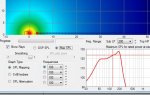
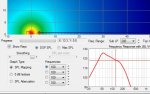
Here are a couple screenshots from JBL's LAC:


4883 MAX1m.JPG4883 DSP1m.JPG

The setup is 1 4883 on the floor with the front of the sub at the 0 line. The SPL plot is with a probe at 1 meter at the centerline of the sub. The difference between the two graphs is the selection of "DSP SPL" vs "MAX SPL".

From the LAC manual:
When “DSP SPL” is selected, modeling results reflect
VerTec V4 DSP tonal balance, including high frequency section pre-emphasis and
low frequency contour characteristics. “DSP SPL” predictions for all full-range
VT models are scaled to a 120 dB SPL @ 1m on-axis reference level and provide an
indication of continuous, unweighted RMS SPL with approximately 10 dB of system
headroom remaining.

When “Max SPL” is selected, rated sensitivity and
electrical power handling are used to determine the maximum peak SPL for the
frequency of interest, providing an indication as to available system headroom.

Neither graph shows anything anywhere close to 139dB, though based on the description above, it would seem that the "MAX SPL" graph should.

It's too bad that they don't include SRX728s in the LAC - I know a lot of folks use them with Vertec.

Edit: Playing with the EQ in LAC allows me to apparently get almost 160dB out of a single 4883. Assuming this is true and not the lack of validation of the speaker's real capability in the LAC software :roll:, I'll be placing an order for a single 4883 tomorrow, that will more than satisfy my low frequency needs, up to 5000 people or so.
 
Last edited:
Re: Subwoofer comparison SRX728 vs Vertec 4883

If you make speaker buying decision based on marketing spec sheets alone, you might as well go ask a donkey which one they like better. That wonderful 'calculated max spl' is the most meaningless spec ever. It's assuming 100% efficiency of the driver at full power. Yeah, right. And a frequency graph at 1 watt is one thing. What's the frequency graph at show power? Why don't speaker manufacturers post that material? That's where the differences in cabinets will really start to show up. And when the graphs at low power are way different than at high power is when the speaker is impossible to EQ for.

As far as what you're giving up with the dual 12's vs dual 18's it all comes down to physics. Both boxes are great boxes, but the 728 can go lower. 7hz may not sound like a lot, but in reality, the difference can really add up for you. -3db at 40hz means the rolloff starts above 40hz, where it really does matter.
 
Re: Subwoofer comparison SRX728 vs Vertec 4883

If you make speaker buying decision based on marketing spec sheets alone, you might as well go ask a donkey which one they like better.
I'm asking several donkeys. :)
That wonderful 'calculated max spl' is the most meaningless spec ever. It's assuming 100% efficiency of the driver at full power. Yeah, right. And a frequency graph at 1 watt is one thing. What's the frequency graph at show power? Why don't speaker manufacturers post that material?
Looking at the 4883 spec sheet, they don't even list the response at 1 watt - the graph is blank.
That's where the differences in cabinets will really start to show up. And when the graphs at low power are way different than at high power is when the speaker is impossible to EQ for.As far as what you're giving up with the dual 12's vs dual 18's it all comes down to physics. Both boxes are great boxes, but the 728 can go lower. 7hz may not sound like a lot, but in reality, the difference can really add up for you. -3db at 40hz means the rolloff starts above 40hz, where it really does matter.
The tyranny of pro sound is that virtually no one has heard more than a few products - at least at any level allowing for a basis for a well-researched opinion. The SRX728 is probably the best-known sub, not that that is saying much.I'd love subs that go down to 20 Hz, but the reality is that 80% of the gigs I do are in my standard length Chevy Express cargo van. I don't have room for a pair of Nexo RS18 subs - unless that's all I'm carrying, and the 728s are pretty big too - thus the allure of the 4883. I have to be realistic, and if the 4883 is the equal of the 728 even at the expense of some low-frequency extension, the size more than wins for my usage.My fear is that the SRX728 is measured in whole space, which means the 4883 is 3dB down from the SRX728, and therefore considerably less impressive.I'm not going to buy without hearing them, but hearing them - especially in a shootout situation relative to things I'm familiar with - is easier said than done.
 
Re: Subwoofer comparison SRX728 vs Vertec 4883

The tyranny of pro sound is that virtually no one has heard more than a few products - at least at any level allowing for a basis for a well-researched opinion.

That's not necessarily true, but those of us who have probably can't talk about it on a forum. Also we probably haven't heard both of those relatively unusual subs. Everyone has 18s.
 
Re: Subwoofer comparison SRX728 vs Vertec 4883

I've used and abused the 728 and the Vertec 4882 dual 15 sub. The 4882 has just as much output but IMO sounds better, and is about half the size of the 728.

But if you want deep and small I'd take a look at the Danley TH212. It is only 15 inches wide. Should pack nicely in a van down one wall.
 
Re: Subwoofer comparison SRX728 vs Vertec 4883

I've used and abused the 728 and the Vertec 4882 dual 15 sub. The 4882 has just as much output but IMO sounds better, and is about half the size of the 728.

But if you want deep and small I'd take a look at the Danley TH212. It is only 15 inches wide. Should pack nicely in a van down one wall.
The TH212 is 11.25 cu ft and has a -3dB point of 38Hz. At the risk of potentially believing the spec sheets, the extra 2Hz of low-frequency extension don't seem worth almost double the volume.

Thanks for the data point on the 4882. I don't think that's a usable shape for me, but I'm glad to know that they compete and/or exceed the SRX728.
 
Re: Subwoofer comparison SRX728 vs Vertec 4883

That's not necessarily true, but those of us who have probably can't talk about it on a forum. Also we probably haven't heard both of those relatively unusual subs. Everyone has 18s.
I think you're making my point for me - this information is inaccessible to the majority. PMs or other forms of non-forum communications would be most welcome, and would be handled with due discretion.
 
Re: Subwoofer comparison SRX728 vs Vertec 4883

I appreciate all the thoughts so far. I have a call into the JBL app group asking about the measurement specifics of the 4883 relative to their other products. I confess that I'm disappointed in the lack of documentation for the entire 4886/4883 system - it's been out almost 3 years and there's still no owner's manual online, not to mention the lack of data on the 4883 spec sheet. It's one thing when a 3rd tier manufacturer like DBTechnologies has lousy documentation. I expected better from JBL.
 
Re: Subwoofer comparison SRX728 vs Vertec 4883

The TH212 is 11.25 cu ft and has a -3dB point of 38Hz. At the risk of potentially believing the spec sheets, the extra 2Hz of low-frequency extension don't seem worth almost double the volume.

Thanks for the data point on the 4882. I don't think that's a usable shape for me, but I'm glad to know that they compete and/or exceed the SRX728.

The sensitivity of the TH212 is 104dB measured between about 42Hz and 55Hz (it's a little more above that). At what frequencies was the JBL specified?
 
Re: Subwoofer comparison SRX728 vs Vertec 4883

The TH212 is 11.25 cu ft and has a -3dB point of 38Hz. At the risk of potentially believing the spec sheets, the extra 2Hz of low-frequency extension don't seem worth almost double the volume.

Thanks for the data point on the 4882. I don't think that's a usable shape for me, but I'm glad to know that they compete and/or exceed the SRX728.
The question is "exactly what does the -3dB freq ACTUALLY mean?" On the Danley spec sheets, it is 3dB down from the rated sensitivity-that is not always the case with all manufacturers.

If you look at a lot of MEASURED RESPONSES (from various manufacturers)- you will see that the "quoted -3dB) is NOT 3 db down from the rated sensitivity (it is for some but not for all-don't make ANY assumptions-and they vary within different products from the same manufacturer)-they HAVE to be tied together-or else both are meaningless. I have seen cases where the quoted -3dB freq is ACTUALLY 9-10 dB from rated sensitivity.

If they are tied together-then a manufacturer has to "choose" whether the numbers should say a lower freq extension AND a lower sensitivity or have a higher sensitivity AND a higher low freq number. It is NOT a matter of choosing the "best of both worlds" but lots of manufacturers do-incorrectly.

Of course without a measured graph-you only have the numbers to go on-and then that raises a lot of other questions-where did the actual sensitivity number come from? What is the REAL -3/-10dB point-is it in half or full space and so forth.

You ALSO have to look at whether or not there is any DSP "boost" applied down low to get that number. If there is (very common these days), the you HAVE to SUBTRACT that amount of boost (often as much as 6dB or more) from the maximum output rating-at least at the freq at which the boost was applied.

So these cabinets may "appear" to go lower at low power levels-but when you ramp it up to loud levels-the low freq cannot keep up.

Just things you HAVE to keep in mind when looking at the "simple spec numbers". They are not always as they appear.
 
Re: Subwoofer comparison SRX728 vs Vertec 4883

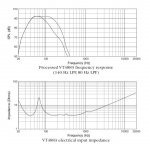
Someone at JBL must be listening, as in the last day or two they added the response graph to the 4883 spec sheet. This wasn't there as of Sunday. Here are the graphs:
4883 graphs.JPG

As Ivan expected, this is a "processed" graph.

Poking around in LAC this morning reveals the following:

Using the "DSP SPL" option, single speaker, 1 meter
[TABLE="width: 500"]
[TR]
[TD]Subwoofer[/TD]
[TD]31Hz[/TD]
[TD]40Hz[/TD]
[TD]50Hz[/TD]
[/TR]
[TR]
[TD]4882 (larger - dual 15" est 13.3cu ft)[/TD]
[TD]119.3dB[/TD]
[TD]127.8dB[/TD]
[TD]127.3dB[/TD]
[/TR]
[TR]
[TD]4883 (little guy - dual 12" 5.25cu ft)[/TD]
[TD]112.8dB[/TD]
[TD]120.3dB[/TD]
[TD]125.8dB[/TD]
[/TR]
[TR]
[TD]4881 (single 18" 10.4cu ft)[/TD]
[TD]110.3dB[/TD]
[TD]116.3dB[/TD]
[TD]117.8dB[/TD]
[/TR]
[/TABLE]
 
Last edited:
Re: Subwoofer comparison SRX728 vs Vertec 4883

Pretty darn impressive ESP for the size of the box. It really is quite small. I would love to hear one myself.
 
Re: Subwoofer comparison SRX728 vs Vertec 4883

I tried out LAC version 1.2. The same setup as above produces completely different results for the 4883 compared to LAC 1.1:

31Hz:109.3dB, 40Hz:115.3dB, 50Hz:116.8dB

I also called around inside the JBL mothership and talked to one of the engineers of the 4883. He gave me a graph of the actual measurement of the product. I'm not sure if I'm at liberty to post it, but a couple of interesting things that stuck out to me - the +/-3dB range on the spec sheet is 40Hz - 300Hz. The measured level range over ths band is about 17dB. I'm assuming they are ignoring some of the high-frequency output to focus on the range most folks would consider for subwoofer use.

The box appears to be flat from 50Hz to 100Hz, and about 4dB down at 40Hz. Extrapolating this, the peak output for the box should be 134dB at 40Hz, and about 130 at 35Hz. The LAC 1.2 numbers are 19dB less at 40Hz, and about 17dB less at 31Hz.

I'm running out of mileage on the spec sheets - time to get a demo.
 
Re: Subwoofer comparison SRX728 vs Vertec 4883

I also called around inside the JBL mothership and talked to one of the engineers of the 4883. He gave me a graph of the actual measurement of the product. I'm not sure if I'm at liberty to post it, but a couple of interesting things that stuck out to me - the +/-3dB range on the spec sheet is 40Hz - 300Hz. The measured level range over ths band is about 17dB. I'm assuming they are ignoring some of the high-frequency output to focus on the range most folks would consider for subwoofer use.

The box appears to be flat from 50Hz to 100Hz, and about 4dB down at 40Hz. Extrapolating this, the peak output for the box should be 134dB at 40Hz, and about 130 at 35Hz. The LAC 1.2 numbers are 19dB less at 40Hz, and about 17dB less at 31Hz.

I'm running out of mileage on the spec sheets - time to get a demo.
Was that graph with or without processing applied?

If you only see the processed graph-then you have no idea what the raw response of the cabinet is-especially down low. It is VERY common these days for manufacturers to put a boost down low to make the cabinet appear to go lower.

yes it can do that-at the lower levels-HOWEVER-if you turn the cabinet up, whatever boost you have applied (often 6dB or more) HAS to be subtracted from the max output (at the freq it is applied)-because the driver simply can't handle it.

And then the whole "1 watt thing" goes out the window-as they are no longer appling 1 watt to the cabinet for the graph.

I have no idea which way is which-but the previous graph say 'processed"-so that really doesn't say a whole lot.

I like the way EAW does on a lot of cabinets (sadly not all). They show you the unprocessed response-the processors response (where you can easily see the bossts that may be applied) and the final result.

With the unprocessed graph-you gan get a better idea of the cabinet is actually capable of doing-especially when turned up.

This gives way more information than a simple processed response. I would HOPE that a processed response is pretty flat-if not-something is wrong.

Of course HF boosts are also common-but most people don't seem to care about that as much. But that can also add additional heating to the voice coil-and additional distortion because you are asking the driver to do something it can't-at least easily. And the HF boosts aren't as likely to cause damage (at least as much as the low freq boosts) from overexcursion or overheating.
 
Re: Subwoofer comparison SRX728 vs Vertec 4883

Was that graph with or without processing applied?

If you only see the processed graph-then you have no idea what the raw response of the cabinet is-especially down low. It is VERY common these days for manufacturers to put a boost down low to make the cabinet appear to go lower.

Not only is this common, it was a requirement in some of the original alignments that were proposed by Small for vented boxes.

yes it can do that-at the lower levels-HOWEVER-if you turn the cabinet up, whatever boost you have applied (often 6dB or more) HAS to be subtracted from the max output (at the freq it is applied)-because the driver simply can't handle it.

TJ,

It should be pointed out that Ivan's statement above is a good rule of thumb, but it is not strictly true. I'll attempt to explain for the classic bass reflex/vented box loudspeaker:
  1. A vented box has an excursion minima at the box tuning frequency, Fb. The air in the port provides the lion' share of the acoustic output, and the cone moves very little at this frequency.
  2. About a half octave above the tuning frequency, the port no longer has any effect on output, and the driver will experience its maximum excursion.
  3. Because the excursion near Fb is lower, and the port provides most of the output, a narrow boost near Fb does not incur a great penalty increase in driver excursion.
  4. A boost 1/2 octave above Fb will typically result in the maximum increase in driver excursion, and is to be avoided.
  5. The driver impedance is closest to purely resistive at Fb, so a boost here results in more power dissipation in the voice coil. Because the boost is narrow, however, the overall increase in voice coil heating is usually fairly minor.
  6. Driving the air in the port harder at Fb to beef up the low end response is going to speed the onset of port nonlinearities. Therefore the effectiveness of the boost at Fb for increasing output depends on the port behaving well. Once the port starts behaving badly, the benefits of the boost are lost. This results in less output, but it is as much because of the port as the driver.
  7. As the port behaves worse, it provides less excursion protection to the driver, and eventually this reduced excursion protection will result in the driver's strain. Typically, though, the port is making all kind of terrible noises before this happens, and therefore is the arbiter of maximum output.

So, in summary, a boost at Fb will give you more practical output, with little downside, until the port gives out. The more the boost the sooner this will happen, and the more dependent the maximum output becomes on the porting.

Basing maximum SPL discussion on nominal 1W sensitivity ratings is not useful, as the 1W values provide no insight into the things that limit maximum output. Also, the electrical input ==> acoustic power can be calculated directly from the Theile Small parameters, and there's no need to look at a datasheet for these values.

In a perfect world where ports and boxes behaved in a completely linear fashion at all drive levels, and drivers never did anything nasty with increasing excursion, a 12" driver is going to need approx 1.8x the linear excursion capability to match the output of an 18" driver. This is not impossible, but it is not likely for two drivers based on the same underlying motor geometry. Depending on how much output you truly need, this may not be a big deal.

---

A tapped horn style design has two excursion minima, and provides better excursion protection for the driver. Tapped horns are not immune from air nonlinearities as the output increases, but generally fair better in this regard than a vented box. Air velocities are globally lower than the typical ported box, and the maximum velocities are near the large mouth, and low near the small throat.