

Horn theory questions

Can you make any driver go really low with a specifically designed horn? Such as could I take an old EV 10 or 12 (or something of equivalent midrange performance) and get 30Hz out of it with a horn if you have no size or folding restrictions? -More "in theory" as opposed to actually build-able results?

(just trying to settle an argument with someone and I honestly don't know other than what I've used or heard)
 
Re: Horn theory questions

I'm no expert, but the bigger the horn the lower the frequency you'd get pattern control at
actual output depends on driver specs and box volume matching. any speaker will go as low as you want, just depends on how efficient it is at that freq.

Jason
 
Re: Horn theory questions

Can you make any driver go really low with a specifically designed horn? Such as could I take an old EV 10 or 12 (or something of equivalent midrange performance) and get 30Hz out of it with a horn if you have no size or folding restrictions? -More "in theory" as opposed to actually build-able results?

(just trying to settle an argument with someone and I honestly don't know other than what I've used or heard)
EV 10M has a FS of 65 Hz, Xmax of only 2.8mm, EV 12L 55Hz and 3.3mm.
Compare that to a decent LF horn driver, the Eminence Lab 12, with a 22Hz Fs and 13mm Xmax.
Building a very large horn to try to reach 30 Hz with either driver is a waste of wood, unless you don't care for much LF output.
Either EV driver can work well in a horn designed to go to the FS or a bit below, and can hit some rather amazing levels (close to 130 dB) with a few hundred watts.
With a tapped horn you can cheat down quite a bit lower than the FS, but 55 Hz is almost an octave above 30 Hz.
 
Re: Horn theory questions

Let's approach this in a different way. The EV10M will produce 30hz, albeit at a very low level. If you built a proper 30hz horn and loaded the 10M on it, it would produce 30hz louder than before, because you have the horn's gain applied to the original signal level.

It is highly likely, however, that any given single 18 in a reflex box would still outperform your horn loaded 10M. Simply because the 18 could produce so much more at 30hz in the first place.
 
Re: Horn theory questions

Thanks guys.
Was just in an argument that you can get flat LF response out of any driver with a massive horn of proper proportions. I just chose an EV as an example as it's something I'm familiar with and know they are definitely NOT a subwoofer-class driver.
Part of the discussion was about old western electric talking-movie horns that had 555 compression-drivers on stupid-long coiled horns with 6' square mouths and they were getting 100Hz out of the things.
So in theory I may have lost the argument, but in practicality it's just not realistic. However I may see some crazy projects of mine in the future as I have plenty of space, tons of time in the winter to build things and a large collection of random drivers.
 
Re: Horn theory questions

Thanks guys.
Was just in an argument that you can get flat LF response out of any driver with a massive horn of proper proportions. I just chose an EV as an example as it's something I'm familiar with and know they are definitely NOT a subwoofer-class driver.
Part of the discussion was about old western electric talking-movie horns that had 555 compression-drivers on stupid-long coiled horns with 6' square mouths and they were getting 100Hz out of the things.
So in theory I may have lost the argument, but in practicality it's just not realistic. However I may see some crazy projects of mine in the future as I have plenty of space, tons of time in the winter to build things and a large collection of random drivers.
Getting 100 Hz out of a "full range" compression driver is possible with a very large horn, but LF level is very limited due to the very small linear range (Xmax) and (relatively) small diaphragm diameter.
In this thread:
Western Electric 1928 - How far have we come in the last 100 years? - Page 101 - diyAudio
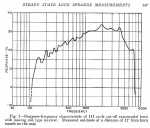
Post #1010 Speaker Dave posts some W.E. response curves.

A single large horn using a W.E. 555 will not be flat on axis in an outdoor or anechoic environment.
As you can see, the on axis outdoor response is over 40 dB down at 100 Hz compared to the 1-4K range.
That kind of response, with it's narrowing upper on axis response, can combine to a fairly flat response with multiple units covering various theater locations.
The 555 LF output potential will still not approach that of a cone driver, as the 555 diaphragm displacement is a fraction of even an "old school" 10" or 12" driver as mentioned in posts # 1 and 3 above.
 

Attachments

  • 115 FC.png
    115 FC.png
    278.5 KB · Views: 1