Crest Pro-Lite Questions - Two 3.0 bridged or one 7.5 for a pair of Danley TH118?

Re: Crest Pro-Lite Questions - Two 3.0 bridged or one 7.5 for a pair of Danley TH118

You are confusing brand image with product performance. While Danley as a brand deserves to be considered along with the other elite brands, do not dismiss Danley the man's judgement when it comes to selecting an amplifier.

Where a product is manufactured does not predict performance or reliability. Design, component quality, and manufacturing discipline does.

I trust TD's engineering chops and judgement. Since I am one of the few people posting to this thread that has even been inside a Chinese factory I believe I can have an informed opinion about that too. Where a product is assembled does not matter. If enough customers were willing to pay the extra dollars to assemble amps in the US, Hartley would still build them here.

JR

PS: @ Tim at least one of Crest's senior amp designers left Crest and joined Peavey well before they bought Crest.

John,

As Ivan stated,
"Lab and Crown are associated with other "families of products" and while a relationship has been tried (from what I understand) the "loudspeaker arms" of the family would not "allow" the amp 'arms" to align with Danley. I don't know all the details on this or exactly what happened."

So what I feel is Danley is suggesting amps, only because he cant suggest what he really would like. I just don't believe a power lite will compete, with powersoft, Lab, crown, or even crest pro 200, heck I rather use ca over 200 series, but there to dam heavy,,,, Along with what my local repair shop has already seen with the ipr / powerlite. I'd leave them to monitor duty at the most. I'd just like to know what would be recommended if someone wanted to put one of these other brands on it. Looks at Danleys amps are the whole Crest 200 series. 5,7,8,9200. Don't know what the eda 12,000 is or who makes it.

I see the crest 7500, crest pro 9200, powersoft k6, lab fp 7000 all be in about the same power out put. So $1000, $2200, $5000, $5000.
 
Re: Crest Pro-Lite Questions - Two 3.0 bridged or one 7.5 for a pair of Danley TH118

There is no "perfect output power".

The size of the amp depends A LOT on the style of music-the crest factor and so forth.

And even when stating a particular style of music-there are variances between different songs.

As the saying goes. Tel the SONG (the ONLY SONG) that you will be playing on the system-then it could be analyzed with freq content-duration-crest factor and so forth and an amplifier could be suggested.

But if you are looking for "the perfect" amplifier-as soon as you play another song a different wattage would probably be suggested.

How much difference would their be? Probably not enough so as to be a real concern.

Of course in the perfect world the system would not be pushed up against the limits of the amps, so as long as the amp was "a decent size" all would be fine.

However this does not happen in the real world.

What our "general suggestion" as to amp size for the TH118 is in the range of 2000-3000 watts @ 4 ohms. That is just a 1.7dB difference. And if that difference is going to "make or break" the system, I suggest a larger system.

I may be getting at, what amp that doesn't lets say fall on it face and current limit itself after 2 kickdrum hits because the power supply cant keep up.

Kinda like my senario. I use a crest 8200 bridged into 1 double 18. I used to use 1 ca 18 in stereo, half the power, and the ca sounded just as good as 2 8200's.

I won't comment on what 1 old crown 5k in stereo does compared to a 9200 in stereo on bh800's....

I just feel if you want the old big sound and power with these new d , switching power supply amps, you have to spend big money, for light weight that works.

Please remeber, Im just a weekend warrior, but I've seen enough, heard enough, to convince me.
 
Re: Crest Pro-Lite Questions - Two 3.0 bridged or one 7.5 for a pair of Danley TH118

I may be getting at, what amp that doesn't lets say fall on it face and current limit itself after 2 kickdrum hits because the power supply cant keep up.

If you are running your amplifier on a 20A 120V circuit, you won't get more than 2400W continuous out of the amplifier, ever. Any amplifier with a maximum output greater than that on that size circuit MUST employ some form of current limiting, or the upstream circuit breaker will trip. The design tradeoffs in this limiting are, of course, up to the individual amplifier designer

It was not uncommon to run the bigger Macrotechs on 30A circuits, and the same really needs to be done with the lightweight amplifiers for a fair comparison. This is borne out in the current draw ratings for the Crest amplifiers under discussion here. I'm assuming you've used similar power distribution for your comparisons?
 
Re: Crest Pro-Lite Questions - Two 3.0 bridged or one 7.5 for a pair of Danley TH118

If you are running your amplifier on a 20A 120V circuit, you won't get more than 2400W continuous out of the amplifier, ever. Any amplifier with a maximum output greater than that on that size circuit MUST employ some form of current limiting, or the upstream circuit breaker will trip. The design tradeoffs in this limiting are, of course, up to the individual amplifier designer

It was not uncommon to run the bigger Macrotechs on 30A circuits, and the same really needs to be done with the lightweight amplifiers for a fair comparison. This is borne out in the current draw ratings for the Crest amplifiers under discussion here. I'm assuming you've used similar power distribution for your comparisons?


Yes as far as power, 20 amp crcuits. I prove current limiting all the time with my crest 8200's. I run 2 of them bridged on 1 20 amp circuit. A few times a night the acl light comes on. I've also put a amp meter on the circuit as a test, while the acl, clip light was lighting quite constant, like every hit of the kick drum. it was drawing 28 amps peaks for two amps, then way back down between hits. Now a 8200 is suppose to be 4500watts bridged, that would be 9000 for two. In 4 years I tripped 1 20 amp breaker playing at many different venues.

I've tried bridging my ca 18's on subs, 2 per circuit. That never worked out.

You stated, "Any amplifier with a maximum output greater than that on that size circuit MUST employ some form of current limiting," I'm pretty sure music is a lot less demanding then putting a amp on a bench and trying to get its rated outage for 5 seconds straight..

It just seems that these new lighter weight amps, at same given output power, power supplies shut down a lot faster then the old amps??
 
Re: Crest Pro-Lite Questions - Two 3.0 bridged or one 7.5 for a pair of Danley TH118

http://www.diy.poweraudio.ro/albums/userpics/10001/BENCH_COMPARISON_TEST.pdf

Stuff like this,

As shown, the fP6400 suffers when trying to follow the
envelope of the input signal. The distortion value grows
with the output power. During long-duration use, the
limitations of the power supply in this amplifier will be
evident. Their fold-back limiter will turn on and drastically
reduce the signal.

Before clipping, the fP behavior is relatively linear.
Again, it is very clear to see the limitation of the
power supply in long duration performances, with a
typical fall-back limiter drastically reducing the output
power.

Looking at the fP chart you can see that, starting
from the second cycle, the energy is slightly cut.
After that it remains more or less at the same level.
The performance of the IT is good, both for the peak
level and for the holding time.
For this specific test and, thanks to its very high rail
bus voltage, the IT
performs the best. The K10’s measurements are
very close in comparison to the IT.
Take note that the K6 shows a perfect waveform (ie:
not at all limited) thanks to it’s over sized power
supply

The IT requires 10000W from the mains to provide 7000W of Total Output
Power while the K Series consumes 8000W to provide 7000W of Total
Output Power.

Power Loss Vs. Continuous Total Output Power
In the fourth chart, power dissipation is shown using BTU/h
(British Thermal Unit per hour) as units of heat.
Looking at the chart, you can see that in order to produce 7000W of
audio
power, the IT dissipates 10000 BTU, while the K Series uses only 4000
BTU (less than half). In other words, with the same amount of heat
dissipation, you can use more than double the amount of K Series
amplifiers verses ITs and you get more than double the amount of audio
power.
You will notice that, with the same heat dissipation, the fP is providing
3200W of power verses 7000W from the K Series.
In conclusion, we can certainly say that fP and IT amplifiers are much
more expensive to run verses the K Series in terms of power consumption
and air conditioning requirements.
These measurements have been performed at 230V. The K Series
amplifiers’ performance will remain more or less the same (less than 1%
lower) at 120V mains.
22

Power Vs Time With Both Channels Driven
These charts show the output power of the amps Vs.
time at 8-Ohms, 4-Ohms, and 2-Ohms.
At 8-Ohms, the fP produces a maximum output power
that holds for a few seconds before the power drops. At
4-Ohms after 0.1s, it is visible that the output power
drops due to the power supply’s performance. The
power continues to drop until around 1 second where it
holds steady for about 100 seconds before dropping off
again. At that point, thermal factors begin to reduce the
output power.
At 2-Ohms the fP has a much higher peak power
however, the power supply suffers much sooner. After
about a second, the behavior is more or less the same
as it was with a 4-Ohm load
At 8-Ohms, the IT holds the maximum output power for
about 90 seconds. After that, a protection circuit
reduces the output level to roughly 1000W. Soon after,
thermal factors reduce the output power to 250-300W
only!
At 4-Ohms the IT performs well for over 1 second.
While at 2-Ohms the behavior shows a starting peak
power of 6000W which is then reduced to 4000 just
after 0.1s.
As you can see, the K Series’ performance has been
tuned to produce a very high peak power and hold it for
a long time, regardless of the load.
 
Re: Crest Pro-Lite Questions - Two 3.0 bridged or one 7.5 for a pair of Danley TH118

With this above test, I could only imagine how a power lite would fair??????

Yes, you can only "imagine", unless you actually test one.

Too much blather to respond to every supposition but a few from the top;
1- there is no correlation between weight or size in output unless all else is held exactly the same, and not completely then.

2- yes, continuous power is limited by the mains voltage/current product, while music routinely demands lesser duty cycles. That said amplifiers can not effectively save energy for later use for more than a small fraction of a second (typically mSecs).

3- Don't ASSume that none of your hero brands are made in China too. The operative criteria is generally sales volume and how price competitive of a market the amps are in. A Low volume product is too difficult to manage several continents away.

4- Amplifiers are a mature technology and the latest generation are delivering remarkable price/performance. The amplifiers are generally engineered to deliver the amount of duty cycle the customers need. Putting in too much capability, adds cost that can hinder sales in the margin.

5- Business associations are driven by mutual benefit, Danley being independent and relatively new to the market has less opportunities to partner than older brands.

Of course I have no first hand information about the innards of these amps, or business dealings involved.

Merry Christmas.

JR
 
Re: Crest Pro-Lite Questions - Two 3.0 bridged or one 7.5 for a pair of Danley TH118

Yes, you can only "imagine", unless you actually test one.

Too much blather to respond to every supposition but a few from the top;
1- there is no correlation between weight or size in output unless all else is held exactly the same, and not completely then.

2- yes, continuous power is limited by the mains voltage/current product, while music routinely demands lesser duty cycles. That said amplifiers can not effectively save energy for later use for more than a small fraction of a second (typically mSecs).

3- Don't ASSume that none of your hero brands are made in China too. The operative criteria is generally sales volume and how price competitive of a market the amps are in. A Low volume product is too difficult to manage several continents away.

4- Amplifiers are a mature technology and the latest generation are delivering remarkable price/performance. The amplifiers are generally engineered to deliver the amount of duty cycle the customers need. Putting in too much capability, adds cost that can hinder sales in the margin.

5- Business associations are driven by mutual benefit, Danley being independent and relatively new to the market has less opportunities to partner than older brands.

Of course I have no first hand information about the innards of these amps, or business dealings involved.

Merry Christmas.

JR

Merry Christmas to you also JR. Thanks again for getting me in contact with the people I needed to, to get my desk repaired a few years ago also!!
 
Re: Crest Pro-Lite Questions - Two 3.0 bridged or one 7.5 for a pair of Danley TH118

Yes, you can only "imagine", unless you actually test one.


4- Amplifiers are a mature technology and the latest generation are delivering remarkable price/performance. The amplifiers are generally engineered to deliver the amount of duty cycle the customers need. Putting in too much capability, adds cost that can hinder sales in the margin.


Merry Christmas.

JR
I have entire wall of my office (floor to ceiling) full of old "heavy" amplifiers.

The modern amps run circles around those-with much more power-less weight-smaller-more efficient and so forth.

It is not always the size of the transformer, but rather how the power supply is managed-as you well know.

Modern switching supplies are light years from the old designs (but they are a lot more complicated) and weigh almost nothing.
 
Re: Crest Pro-Lite Questions - Two 3.0 bridged or one 7.5 for a pair of Danley TH118

Here is a review made by Elliot Thompson on the Speakerplans forum. It gives some insight and apparently he likes the results.

http://forum.speakerplans.com/peavey-ipr2-7500-review-very-long_topic89043_page1.html

So I read through that thread and I find it very entertaining, and somewhat telling, that the people who are actually using the IPR or ProLITE amplifiers really like them while everyone else is throwing rocks.

I know this much, after getting Pro9200 amplifiers to displace the Crown 5002's, a regional company received many positive comments from people who were touring with bands that had used the rig before and then used the very same rig again afterwards. They all really liked the change. The regional company appreciated the fact that they lost a LOT of weight from the sub amp racks without losing any perceptible performance, they also appreciated significantly fewer repairs, and any repairs that are necessary are covered under their new 5 year warranty. From a business perspective it was a no-brainer move. From an audio perspective it was a step up.

I will note that they also have a number of FP-6400 amps and had tried them on subs at one point and were extremely dismayed. They would not have considered using the Pro9200 without significant encouragement.

As has been said before in this forum, this is a great time to be involved in this business!
 
Re: Crest Pro-Lite Questions - Two 3.0 bridged or one 7.5 for a pair of Danley TH118

I have entire wall of my office (floor to ceiling) full of old "heavy" amplifiers.

The modern amps run circles around those-with much more power-less weight-smaller-more efficient and so forth.

It is not always the size of the transformer, but rather how the power supply is managed-as you well know.

Modern switching supplies are light years from the old designs (but they are a lot more complicated) and weigh almost nothing.

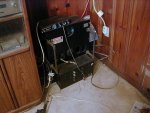
I'll show you heavy amps... My dad used to work for WE and I found an old circa 1930s WE amp in the basement years ago. It was something like a few watts, but filled up 5-6' of 19" eia rack space. In the '70s I decided to make my own "heavy" 4x250W amp. So I gutted just the PS section of that WE amp about 2' tall and used that for my modern (cough) solid state amp. I bolted a 65# power transformer inside the already heavy steel chassis with several pounds of aluminum heat sink for good measure.

My judgement is that if a thief decides to steal my amp I will have to hold the door for him because he will surely need both hands to lift it. :-)

JR

PS Not a great picture but amp is still in my living room and worked the last time I turned it on.
 

Attachments

  • P1010072.JPG
    P1010072.JPG
    60.2 KB · Views: 0
Re: Crest Pro-Lite Questions - Two 3.0 bridged or one 7.5 for a pair of Danley TH118

I'll show you heavy amps... My dad used to work for WE and I found an old circa 1930s WE amp in the basement years ago. It was something like a few watts, but filled up 5-6' of 19" eia rack space. In the '70s I decided to make my own "heavy" 4x250W amp. So I gutted just the PS section of that WE amp about 2' tall and used that for my modern (cough) solid state amp. I bolted a 65# power transformer inside the already heavy steel chassis with several pounds of aluminum heat sink for good measure.

My judgement is that if a thief decides to steal my amp I will have to hold the door for him because he will surely need both hands to lift it. :-)

JR

PS Not a great picture but amp is still in my living room and worked the last time I turned it on.
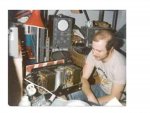
Here is a photo of one of the early amps I built. It was the largest at the time (4x100 watt).

The transfomers were ones I got surplus and had MANY extra taps (and wire) on them that I did not need, but cost was the biggest issue to me at the time.

The heatsink was actually an old stop sign that was folded up.

Notice the old scope and signal generator in the background.

Later I built a 8 x 100watt amp and it used a separate power supply that had to weigh over 100lbs. I don't have a photo of it on my computer-I need to find it and scan it.

I used those (and many others I built) for quite a few years in my early rental days.

Oh how times have changed
 

Attachments

  • 4x100w.jpg
    4x100w.jpg
    48.9 KB · Views: 1
Re: Crest Pro-Lite Questions - Two 3.0 bridged or one 7.5 for a pair of Danley TH118

http://www.abeltronics.co.uk/amptesting.php?z=crest_audio_PRO-9200

When I read a test like this, then they say this

"2R performance was measured with one channel driven only, because excessive sine testing caused the power supply to go into overcurrent protect. "

I see no mention of it doing this to protect the outlet, just the power supply.

As far as heavy amps, I'm only refering to crest ca and crown 5000, and 3600. Thats the only so called heavy amps I'm refering to.
 
Re: Crest Pro-Lite Questions - Two 3.0 bridged or one 7.5 for a pair of Danley TH118

http://www.abeltronics.co.uk/amptesting.php?z=crest_audio_PRO-9200

When I read a test like this, then they say this

"2R performance was measured with one channel driven only, because excessive sine testing caused the power supply to go into overcurrent protect. "

I see no mention of it doing this to protect the outlet, just the power supply.

As far as heavy amps, I'm only refering to crest ca and crown 5000, and 3600. Thats the only so called heavy amps I'm refering to.

I spent too many years trying to explain to customers about the difficulty in trying to translate simple sine wave testing to real world music reproduction.

Music with a very few obscure exceptions does not consist of full scale sine waves held for seconds at a time**. Many amplifiers will shut down after only seconds of driving a dummy load to full power. Don't try driving your speakers that way, while standing in the same room (my ears are bleeding).

As i have said before and recently, amp designers put in the amount of power output duty cycle that the majority of their customer need, not what they think they want. The days of 24x7 full continuous power amplifier went the way of the dodo bird along with 4 ohm minimum loads and modest power levels.

The higher the power output the less likely any speaker system could survive full application of that power for any duration. Music consists of loud parts and more modest average power levels. In an efficient market where manufacturers respond to customer's buying behavior, amplifiers (and speakers) have evolved to be more like the music (go figure.)

JR

*** there were a few new (new decades ago) genres (like trance?) that involved significantly denser bass content that old school R&R. Also multi-amped systems can impose heavier duty loads on the LF bandpass section than playing wide range.

[edit] The amplifier power stage is dominated by different limitation that the power supply. Amplifier output stages are typically dissipation limited, while power supply is amps times volts. The calculus is somewhat different for class D amps where dissipation is less of a concern and amplifier stages are limited by peak current, but this is getting kind of esoteric. [/edit]
 
Last edited:
Re: Crest Pro-Lite Questions - Two 3.0 bridged or one 7.5 for a pair of Danley TH118

I spent too many years trying to explain to customers about the difficulty in trying to translate simple sine wave testing to real world music reproduction.

Music with a very few obscure exceptions does not consist of full scale sine waves held for seconds at a time**. Many amplifiers will shut down after only seconds of driving a dummy load to full power. Don't try driving your speakers that way, while standing in the same room (my ears are bleeding).

[/edit]
As a wise man said many years ago (before the current days of pulse power) "What we really need is an amplifier that can produce 100 watts continuously and pass 20dB peaks" That would be 10,000 watts for those that don't want to do the math.

The real question is "how long are the peaks". Is it 80ms, 200ms 3 seconds???????????? THAT is the question and I bet most of the users who talk about such things have no idea long long the particular peaks are that they are trying to pass.

Yes it does vary with music styles and sometimes it can be a sine wave for several seconds. Amps that drop their power a good bit (6dB is not uncommon) will not be able to have the "sonic experience" that other amps (that can reproduce that signal for several seconds).

How important is it? Hard to say-especially when you have not experienced a system that can actually do it.
 
Re: Crest Pro-Lite Questions - Two 3.0 bridged or one 7.5 for a pair of Danley TH118

"but this is getting kind of esoteric. "

Well Kendall you might as well get a behringer inuke 6000, $399, has dsp, 3000 watts into 4 ohm stereo. They must have found a better way to do it then powersoft, lab, and so on, as their amps would cost around $5000 for the same power. I dunno.

Haha, I give up. : )

Merry Christmas everyone, have a safe and healthy new year also.
 
Re: Crest Pro-Lite Questions - Two 3.0 bridged or one 7.5 for a pair of Danley TH118

Years ago I wanted to come up with the audio equivalent os a tug of war between competing power amps to see who was king of the jungle, unfortunately it doesn't work that way, the winner of such a tug of war would be the amp with the most output current, not necessarily the one that plays loudest longest.

I suspect a more valid test could be performed by feeding several amps from the same music source, with all driving similar reference loads, and see which ones drop out first. Of course you would need a pretty serious power drop for such a test, and even then winning such a contest is only a relative comparison but what many seem to want.

JR
 
Re: Crest Pro-Lite Questions - Two 3.0 bridged or one 7.5 for a pair of Danley TH118

, and even then winning such a contest is only a relative comparison but what many seem to want.

JR
As evidenced by the quantity of cheap products sold with "fancy numbers" as compared to real products that provide real results.

But it makes noise-and that is all most people are looking for. No matter how bad it sounds-it is "good enough" :(

As long as the customer "believes", then there will be a market.
 
Re: Crest Pro-Lite Questions - Two 3.0 bridged or one 7.5 for a pair of Danley TH118

As evidenced by the quantity of cheap products sold with "fancy numbers" as compared to real products that provide real results.

But it makes noise-and that is all most people are looking for. No matter how bad it sounds-it is "good enough" :(

That's what Ive been getting at the whole time. Thats why I wanted to know a good reccomendation for a real amp.

As far as crest, I'm brand loyal, I just like crest. 17 years with old ca amps, v series amps, never one failure. I have 10 8200's, 3 9200's. 3 8200's been to the shop, 1 9200 been to the shop, 2 of my buddies 9200's I think 1 led works out of the two, local sound company started the 9200's on fire, I've seen the boards. Now the power light, a step below the 200 series. Some things you just don't have to test, theres a pretty good chance that its not going to work out well.

I actually have a 9200 in a case next to my amp rack when I do a show,,, thats the confidence I have,,,, But they sound good. I'd love to have some realtest equipment, I would put 1 ca 18 up against 2 bridged 8200's. My little cheap radio shack db meter showed the same db at clipping. So somethings limiting with these new power supplys.

I almost would spend the $399 on a inuke 6000, id love to see how fast it started on fire, then again, it probably protects itself and puts out 1/3 the rated power...

Well everyone have a great evening, Im off to see some local bands and stuff myself full of chicken wings and my two alotted beers for the night.