

I had a chance to hear the Vertec 4886/4883 boxes courtesy of my friends at Farber Sound here in Minneapolis. We compared 3 4886 boxes with and without 4883 subs powered by an ITech HD12000 running v4 presets against a single-amped VRX rig, a bi-amped VRX rig, and my single-amped JFL rig.
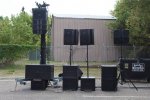
The 4886 boxes were suspended from a 4883 from a Genie lift. A second 4883 was on the ground to demonstrate a SOS-system using the 4883s as a sub. We never ran both of these at the same time - we always ran either the ground box or the flown box. Processing was done using the Vertec presets in the ITech HD and controlled with System Architect.
We had two VRX setups - a single-amped no EQ version, and a bi-amped VRX version running Farber Sound's tuning. Both of these were powered with first-gen ITechs. I don't recall if they were 4000s or 8000s.
My JFL rig was powered by a QSC PLX3402 in stereo mode to the JFL210s (single amped) and a PL236 bridged into either one or two subs, depending on the test, both processed by the latest UX8800 Greyboxes.
My objective for the day was to see if the 4886 boxes were a good replacement for my JFL constant-curve system. While I like the sound quality and general size and logistics of my current system, it's not scalable, and I find myself running into the limiters on most of my gigs (see more about this later). Ideally my next system will still be able to be pole mounted, erectable by one person (at least for SOS versions; I'm OK with flying requiring two people), have at least the same sound quality as my current gear, and have significant scalability for volume and coverage area. I recognize that my testing of only 3 boxes will raise the ire of the "a real line array..." crowd, but the majority of my gigs would be done in a similar fashion, and I wanted to test in the situation I'd be using the gear in.
A secondary objective was to see if the 4883 subs - which on paper are unbelievable - could actually be used as the only subs for a moderate event of a few hundred people.
We ran a number of tests over 3 or 4 hours outside. The area we were testing was about 50' wide and 150' long. Buildings flanked both sides, and though there was a building behind the listening position, it was far enough away that slap back wasn't a big issue. We didn't use any measuring tools other than our ears.
Keeping in mind that my objective was to effectively compare hi-quality SOS arrays and not to do some kind of "real line array comparison", here are my general thoughts.
- VRX with no EQ sounds lousy. I'm not entirely sure why Farber Sound set that up (and we didn't have time to do any tunings), but we quickly moved on.
- VRX biamped with tuning sounds very good, and was surprisingly loud.
- JFL single-amped and under-powered with greybox processing (no user EQ) sounds good but a little more muted compared to the VRX (tuning preferences factor heavily here). Using the first onset of limiting as the gauge of when the speakers are running out of gas, the bi-amped VRX system was noticably louder. This surprised me. I have a suspicion that the JFL limiting turns on a little earlier than how the VRX system was set up, and know from experience that the system holds together and sounds good farther into limiting than we were testing. Nonetheless, the biamped VRX system was clearly louder.
- 4886 boxes sounded fantastic and easily had 10dB of output on my JFL boxes (3 4886 vs. 2 JFL) based on the onset of limiting. I spent a lot of time walking around in the coverage area and tonality didn't change drastically. I was pleased at how little comb filtering there was walking forward and backwards. Side to side consistency seemed good too.
- 4883 boxes when used as subs sound more like how one would expect a 60lb 4.5 cu ft box to sound than how the spec sheet leads one to believe. There was a lot of 60Hz that you felt, but they lacked the smoothness of the VRX918s or JFL118s we compared them to. Running them at full capacity sounded pretty farty.
I know from talking to the Vertec folks at JBL as well as other knowledgeable folks that the 4883 is a "low-frequency extension" box designed to make the 4886 hangs more full range. We ran some tests running the crossover point to 120Hz and letting the 4883 boxes handle the 60Hz - 120Hz octave. While I'm sure that this took significant load off the 4886 boxes, at the volume levels we were able to test at, I didn't hear a huge difference compared to running the 4886 boxes down to 60Hz. For moderate events, I believe the 4883 boxes could be skipped and the 4886 boxes run down far enough for the subs to take over without too many issues.
Other thoughts
With density comes weight. Even though the 4886 boxes only weigh 36lbs, they are so small that they are actually heavier per vertical inch than VRX and JFL. 2 VRX boxes are 90lbs and 27" tall for the pair. 3 4886 boxes plus the U bracket are around 130lbs for 23" of total height.
Vertec rigging is annoying compared to some other systems - parts that aren't captive, anti-vibration o-rings that break immediately, the ability to assemble it wrong - upside down, flipped front to back, etc.
Conclusion
I'm a good capitalist consumer; to quote Queen: "I want it all and I want it now". I want a system that works equally well for 200 people as it does for 1000 people. I want it to sound great, fit in my van, be assemblable by just one person, and run on wall power. I need it to be pole mountable and flyable with variable coverage angles. Other than that, my requirements aren't too demanding.
For various reasons, I've eliminated most trap box solutions. The ones with enough output are physically too large for me to handle by myself. Most are awkward to fly day to day in the room du jour. My constant curve boxes handle a good chunk of my wish list, but lack scalability that I'm finding I need. This makes a small array like the 4886 really attractive. You can fly 18 boxes for a large system, but still make reasonable noise with 3 boxes on a stick. With Vertec processing they sound great. The major issue is cost - a 3 box/side system with amps is close to $20K, not including subs.
I've considered the various B-brands - RCF, DBTech, QSC, FBT, etc., and though they have some interesting solutions which I'm sure sound great, there aren't any folks in my city with that gear, meaning that I'd have to own whatever I'd eventually like to use, rather than owning a small system and cross-renting when necessary. Though I don't do shows at a level where tech riders are iron-clad, it's hard to argue with Orange.
I'm leaning towards going forward with a small 4886 system, and then cross-renting for larger gigs.
The 4886 boxes were suspended from a 4883 from a Genie lift. A second 4883 was on the ground to demonstrate a SOS-system using the 4883s as a sub. We never ran both of these at the same time - we always ran either the ground box or the flown box. Processing was done using the Vertec presets in the ITech HD and controlled with System Architect.
We had two VRX setups - a single-amped no EQ version, and a bi-amped VRX version running Farber Sound's tuning. Both of these were powered with first-gen ITechs. I don't recall if they were 4000s or 8000s.
My JFL rig was powered by a QSC PLX3402 in stereo mode to the JFL210s (single amped) and a PL236 bridged into either one or two subs, depending on the test, both processed by the latest UX8800 Greyboxes.
My objective for the day was to see if the 4886 boxes were a good replacement for my JFL constant-curve system. While I like the sound quality and general size and logistics of my current system, it's not scalable, and I find myself running into the limiters on most of my gigs (see more about this later). Ideally my next system will still be able to be pole mounted, erectable by one person (at least for SOS versions; I'm OK with flying requiring two people), have at least the same sound quality as my current gear, and have significant scalability for volume and coverage area. I recognize that my testing of only 3 boxes will raise the ire of the "a real line array..." crowd, but the majority of my gigs would be done in a similar fashion, and I wanted to test in the situation I'd be using the gear in.
A secondary objective was to see if the 4883 subs - which on paper are unbelievable - could actually be used as the only subs for a moderate event of a few hundred people.
We ran a number of tests over 3 or 4 hours outside. The area we were testing was about 50' wide and 150' long. Buildings flanked both sides, and though there was a building behind the listening position, it was far enough away that slap back wasn't a big issue. We didn't use any measuring tools other than our ears.
Keeping in mind that my objective was to effectively compare hi-quality SOS arrays and not to do some kind of "real line array comparison", here are my general thoughts.
- VRX with no EQ sounds lousy. I'm not entirely sure why Farber Sound set that up (and we didn't have time to do any tunings), but we quickly moved on.
- VRX biamped with tuning sounds very good, and was surprisingly loud.
- JFL single-amped and under-powered with greybox processing (no user EQ) sounds good but a little more muted compared to the VRX (tuning preferences factor heavily here). Using the first onset of limiting as the gauge of when the speakers are running out of gas, the bi-amped VRX system was noticably louder. This surprised me. I have a suspicion that the JFL limiting turns on a little earlier than how the VRX system was set up, and know from experience that the system holds together and sounds good farther into limiting than we were testing. Nonetheless, the biamped VRX system was clearly louder.
- 4886 boxes sounded fantastic and easily had 10dB of output on my JFL boxes (3 4886 vs. 2 JFL) based on the onset of limiting. I spent a lot of time walking around in the coverage area and tonality didn't change drastically. I was pleased at how little comb filtering there was walking forward and backwards. Side to side consistency seemed good too.
- 4883 boxes when used as subs sound more like how one would expect a 60lb 4.5 cu ft box to sound than how the spec sheet leads one to believe. There was a lot of 60Hz that you felt, but they lacked the smoothness of the VRX918s or JFL118s we compared them to. Running them at full capacity sounded pretty farty.
I know from talking to the Vertec folks at JBL as well as other knowledgeable folks that the 4883 is a "low-frequency extension" box designed to make the 4886 hangs more full range. We ran some tests running the crossover point to 120Hz and letting the 4883 boxes handle the 60Hz - 120Hz octave. While I'm sure that this took significant load off the 4886 boxes, at the volume levels we were able to test at, I didn't hear a huge difference compared to running the 4886 boxes down to 60Hz. For moderate events, I believe the 4883 boxes could be skipped and the 4886 boxes run down far enough for the subs to take over without too many issues.
Other thoughts
With density comes weight. Even though the 4886 boxes only weigh 36lbs, they are so small that they are actually heavier per vertical inch than VRX and JFL. 2 VRX boxes are 90lbs and 27" tall for the pair. 3 4886 boxes plus the U bracket are around 130lbs for 23" of total height.
Vertec rigging is annoying compared to some other systems - parts that aren't captive, anti-vibration o-rings that break immediately, the ability to assemble it wrong - upside down, flipped front to back, etc.
Conclusion
I'm a good capitalist consumer; to quote Queen: "I want it all and I want it now". I want a system that works equally well for 200 people as it does for 1000 people. I want it to sound great, fit in my van, be assemblable by just one person, and run on wall power. I need it to be pole mountable and flyable with variable coverage angles. Other than that, my requirements aren't too demanding.
For various reasons, I've eliminated most trap box solutions. The ones with enough output are physically too large for me to handle by myself. Most are awkward to fly day to day in the room du jour. My constant curve boxes handle a good chunk of my wish list, but lack scalability that I'm finding I need. This makes a small array like the 4886 really attractive. You can fly 18 boxes for a large system, but still make reasonable noise with 3 boxes on a stick. With Vertec processing they sound great. The major issue is cost - a 3 box/side system with amps is close to $20K, not including subs.
I've considered the various B-brands - RCF, DBTech, QSC, FBT, etc., and though they have some interesting solutions which I'm sure sound great, there aren't any folks in my city with that gear, meaning that I'd have to own whatever I'd eventually like to use, rather than owning a small system and cross-renting when necessary. Though I don't do shows at a level where tech riders are iron-clad, it's hard to argue with Orange.
I'm leaning towards going forward with a small 4886 system, and then cross-renting for larger gigs.
Attachments
Last edited:

 ~
~